Why Gas Prices Are Rising in 2026: How the Middle East War and the Strait of Hormuz Are Hitting American Drivers
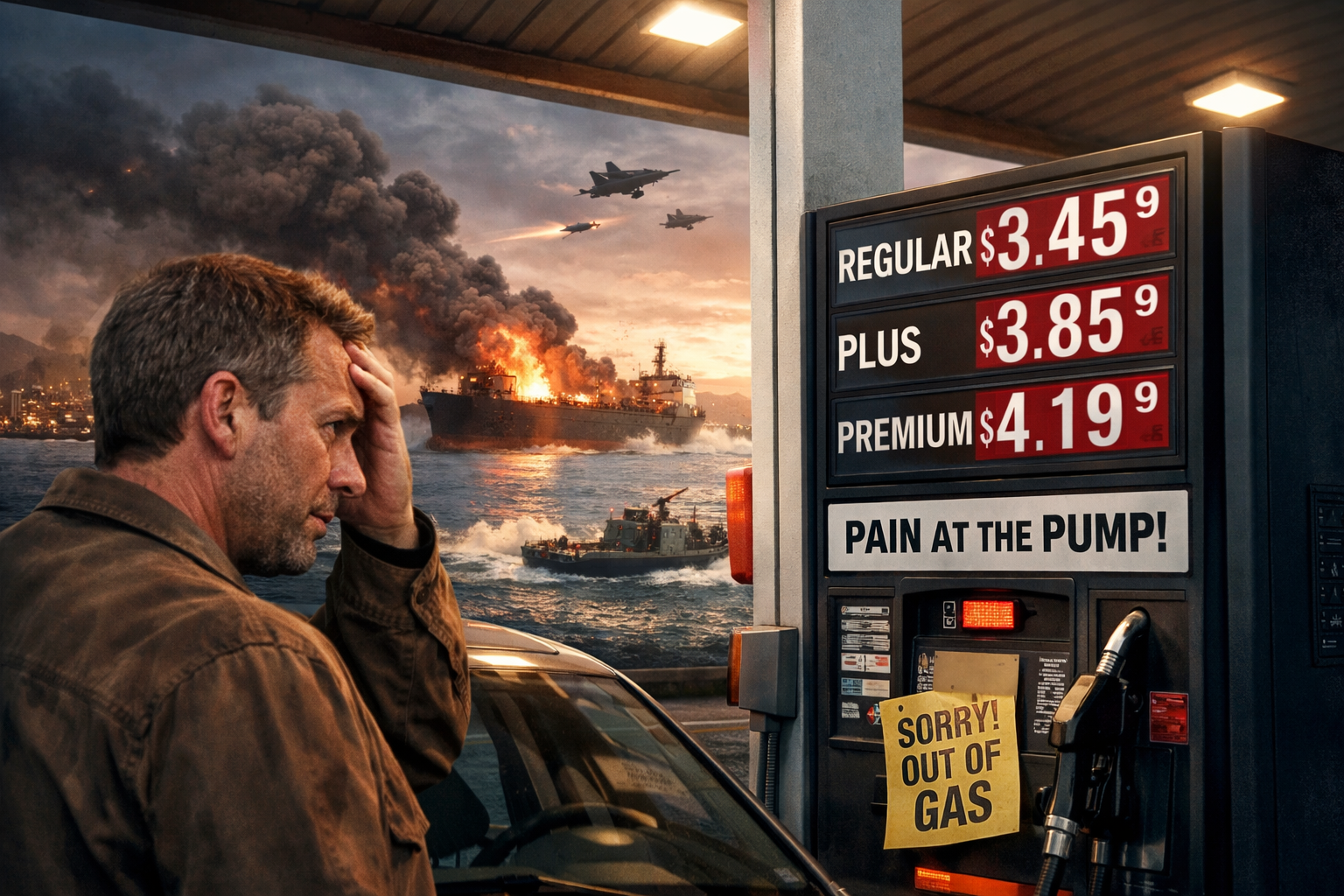
There is a special smell to a fuel panic in America. It smells like hot concrete, bad coffee, and somebody muttering at a gas pump before sunrise. A week ago, the national average for regular gasoline was $2.984. By March 8, 2026, AAA showed it at $3.450. That kind of jump does not happen because commuters suddenly got sentimental. It happens when war escapes the television and crawls directly into the arteries of global commerce. The current conflict involving the United States, Israel, and Iran has rattled shipping in and around the Persian Gulf, with reporting describing traffic through the Strait of Hormuz as effectively stopped or near-halted as attacks, threats, and insurance chaos spread across the water.
U.S. Energy Information Administration
And that is the heart of it: the Strait of Hormuz is not some obscure strip of blue on a map. It is the narrow throat through which modern industry gulps its daily ration of crude and gas. The U.S. Energy Information Administration says oil flow through the strait averaged 20 million barrels per day in 2024, equal to about 20% of global petroleum liquids consumption. EIA also says flows through Hormuz in 2024 and early 2025 made up more than one-quarter of global seaborne oil trade, while about one-fifth of global LNG trade also passed through the same corridor. When traffic there is restricted, the world does not merely worry; it reprices everything with an engine, a furnace, a delivery schedule, or a deadline.
This is why the phrase “limited travel through the Strait of Hormuz” sounds so deceptively mild. There are alternative routes, yes, but not enough to save the day if the choke point stays squeezed. EIA estimates that Saudi and UAE bypass pipelines could provide only about 2.6 million barrels per day of spare capacity in a real disruption, a fraction of what normally moves through Hormuz. In other words, the backup plan is not really a plan; it is a thin emergency bandage wrapped around a severed pipeline of global expectations.
United States and Hormuz
Now comes the part Americans always get wrong. The United States is not as directly dependent on Hormuz barrels as Asia. EIA says the U.S. imported only about 0.5 million barrels per day through the strait in 2024, equal to about 7% of U.S. crude imports and 2% of U.S. petroleum liquids consumption. The country has also been a net total energy exporter since 2019, and EIA reported that the U.S. produced more energy than it consumed in 2024. That sounds comforting right up until you remember the ugly little truth: gasoline is still priced in a global oil market, and EIA says crude oil typically accounts for about half the price of gasoline and diesel. So even when America is not physically short of oil, it can still be financially ambushed by a global supply scare.
The numbers make the point with all the subtlety of a tire iron. Before this crisis, EIA’s February 2026 outlook expected Brent crude to average $58 per barrel in 2026 and U.S. regular gasoline to average $2.91 per gallon. Instead, AAA’s live national average now sits at $3.450, and the market is trading on fear, interruption, and the possibility that this war lasts longer than the optimists in Washington would like to admit. The old forecast belonged to a calmer world. The new price belongs to this one.
The damage does not stop at gasoline. Hormuz is also critical for liquefied natural gas, especially for Asian buyers, and AP reports that the war is choking oil and gas flows broadly enough to raise energy-security alarms across Asia. EIA had already raised its 2026 natural gas outlook after severe winter stress, forecasting Henry Hub around $4.31 per MMBtu for the year. That does not mean American household power bills instantly explode because of one overseas battle. It does mean a prolonged Hormuz disruption can bleed into the wider energy economy through LNG markets, freight costs, petrochemicals, fertilizer, manufacturing, and inflation expectations. Foreign war becomes domestic expense not by magic, but by shipping lanes, contracts, and the pitiless mathematics of energy markets.
So what does this mean for American drivers? It means the war reaches you in fragments. A pricier commute. A more expensive tank before a road trip. Higher delivery costs hiding inside groceries, parts, and household goods. Less room in the family budget when one more thing goes wrong. The likely result is not just pain at the pump; it is a broader squeeze on the cost of daily driving in the United States, especially if the disruption in the Middle East drags on instead of fading quickly. Federal officials are already signaling that the spike could prove temporary if Hormuz traffic normalizes, but that is a hope, not a refund.
And that is where the story circles back to the road, and to the ordinary American driver who did not ask for any of this. When fuel prices rise, every mile matters more. When a crash happens in that environment, the financial shock lands on a household already leaning into the wind. Medical treatment, missed work, vehicle damage, and transportation costs all feel heavier when the price of simply living and driving has climbed. That is why a car accident lawyer or auto accident attorney is not just there to argue about bent steel. The job is to protect injured people when another driver’s negligence collides with an economy that has suddenly become more expensive, more volatile, and less forgiving. For readers of GCTA.law, that is the real takeaway: the Middle East war may begin thousands of miles away, but the bill eventually shows up here, one gallon at a time, and sometimes one collision at a time.